
Unlocking the Future of Learning with Spatial Computing Education Platforms
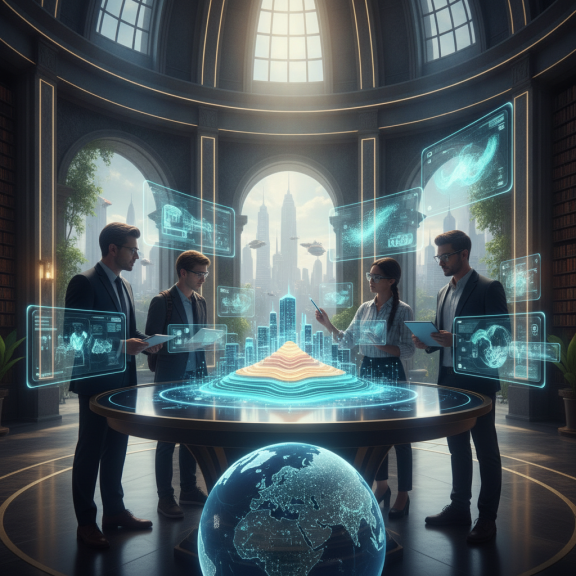
The world of education is on the cusp of a revolution, driven by the convergence of cutting-edge technologies like artificial intelligence, augmented reality, and virtual reality. At the forefront of this transformation is the spatial computing education platform, which promises to redefine the way we learn and interact with knowledge. In this article, we'll delve into the background, key trends, and real-world applications of spatial computing education platforms, and explore how UniVRse is harnessing this power to shape the future of learning.
Background
Spatial computing, a term coined by Microsoft's Alex Kipman, refers to the use of spatial audio, spatial mapping, and spatial interaction to create immersive and interactive experiences. In the context of education, spatial computing enables students to engage with complex concepts and information in a more intuitive and engaging way, breaking free from the constraints of traditional 2D screens and textbooks.
According to a report by MarketsandMarkets, the global spatial computing market is expected to grow from $1.4 billion in 2020 to $13.5 billion by 2025, at a Compound Annual Growth Rate (CAGR) of 44.3%. This exponential growth is driven by the increasing adoption of spatial computing technologies in various industries, including education.
"Spatial computing has the potential to revolutionize the way we learn and interact with information. It's not just about creating immersive experiences, but about creating meaningful connections between people and knowledge." – Alex Kipman, Microsoft
Key Trends
Several key trends are shaping the spatial computing education platform landscape:
- Increased adoption of AR and VR: Augmented reality (AR) and virtual reality (VR) technologies are becoming increasingly accessible and affordable, enabling the widespread adoption of spatial computing in education.
- Integration with AI and machine learning: Spatial computing platforms are being integrated with artificial intelligence (AI) and machine learning (ML) to create personalized and adaptive learning experiences.
- Cloud-based infrastructure: Cloud-based infrastructure is allowing for the scalable deployment of spatial computing platforms, making them accessible to a wider range of users and institutions.
Real-World Applications
Spatial computing education platforms are being applied in a variety of real-world scenarios, including:
- Virtual labs and simulations: Spatial computing enables students to conduct virtual experiments and simulations, reducing costs and increasing safety.
- Interactive textbooks and educational content: Spatial computing platforms are being used to create interactive and immersive educational content, making learning more engaging and effective.
- Virtual field trips and tours: Spatial computing allows students to take virtual field trips and tours, broadening their perspectives and experiences.
"The future of learning is immersive. Spatial computing is not just a technology, it's a mindset shift that's changing the way we approach education." – John Hanke, CEO of Niantic
UniVRse Perspective
At UniVRse, we're harnessing the power of spatial computing to create innovative and immersive educational experiences. Our platform enables users to create, share, and interact with virtual and augmented reality content, making it easy to integrate spatial computing into existing educational workflows.
Our vision is to democratize access to spatial computing, making it accessible to educators and learners around the world. We believe that spatial computing has the potential to revolutionize the way we learn and interact with knowledge, and we're committed to empowering educators and learners to unlock this potential.
Conclusion
The spatial computing education platform is an exciting and rapidly evolving field, with the potential to revolutionize the way we learn and interact with knowledge. As the industry continues to grow and mature, we can expect to see even more innovative applications of spatial computing in education. At UniVRse, we're committed to harnessing the power of spatial computing to shape the future of learning and unlock new possibilities for educators and learners around the world.
Ready to unlock the future of learning with us? Explore our spatial computing education platform today and discover the endless possibilities for immersive and interactive learning.
